The problem comes into focus.
We understand the context and the question that must be answered before investing in the solution.

 EN
Explore the problem, shape a solution and understand what still needs validation. A Proof of Concept helps choose the next step before committing to a build.
Validate my ideaThere is an opportunity, but questions remain about the problem, experience or feasibility. A PoC turns uncertainty into an investigation you can follow.
We understand the context and the question that must be answered before investing in the solution.
Research, existing alternatives and conversations with stakeholders help test assumptions.
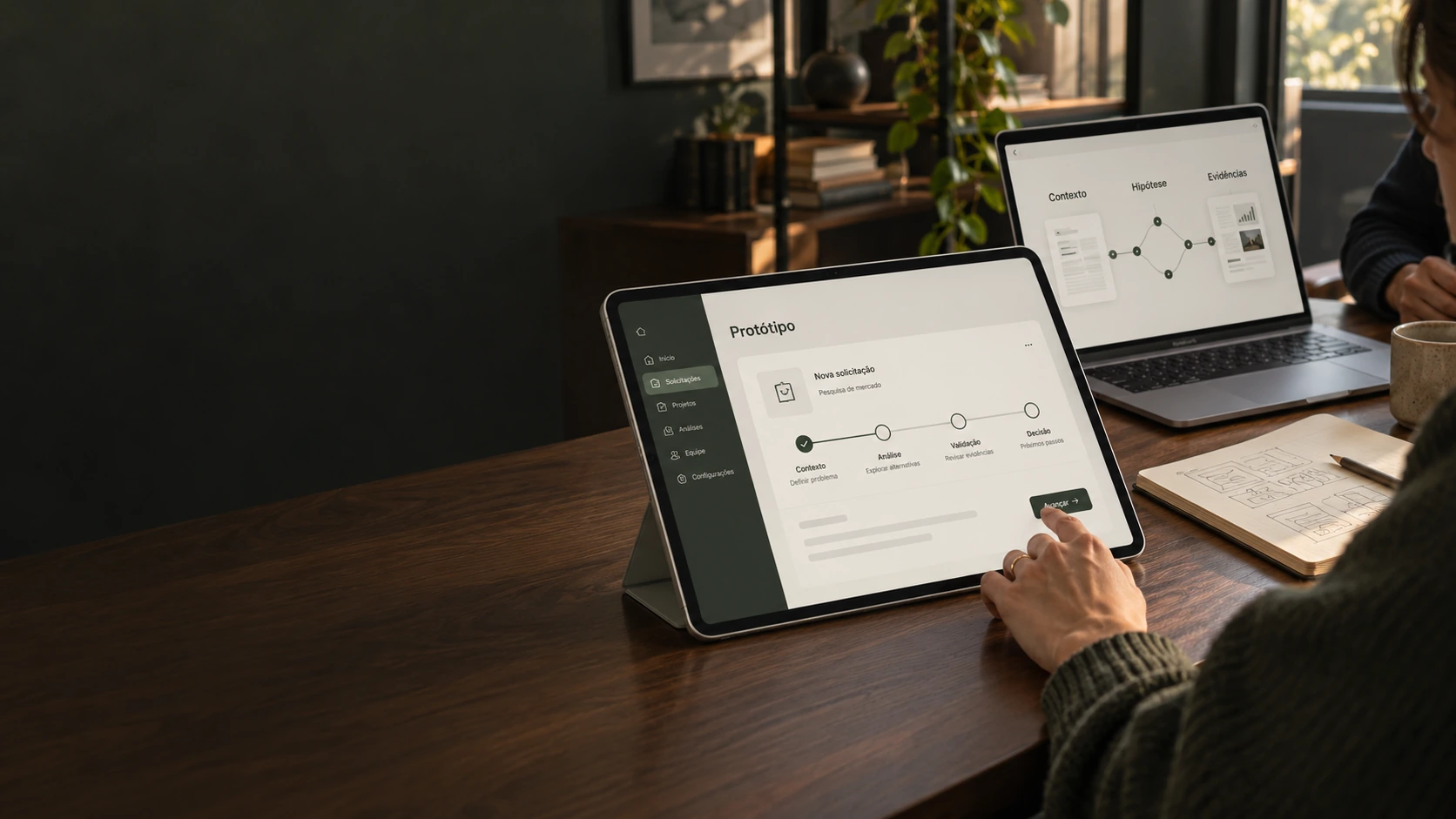
The solution gains a clickable prototype to explore flows and discuss the experience.
You receive an assessment of risks, feasibility and learning to move forward, adjust the idea or stop.
More than visualising an idea. Understand whether it should move forward.
Research, experience and feasibility come together in a deliverable that supports a real decision.
The problem, context and alternatives in one informed view. Understand the proposal and the questions that still matter.
A clickable prototype and solution design to explore the experience and discuss flows, rules and integrations.
An executive summary of risks, feasibility and learning to discuss next steps with partners, leaders, investors or your team.
You take part in the decisions that matter. The investigation advances with context, concrete references and room to change direction.
From hypothesis to decision. With clarity about the next step.
What to know when deciding whether a Proof of Concept fits your needs.
It combines research, solution design, a clickable prototype and a recommendation. The prototype simulates the experience to support a decision; building a production system is a separate project.
You can bring an idea, a pain point or an opportunity. What matters is having a question worth investigating. The PoC helps assess the problem and solution before committing to a build.
The problem, usage context, alternatives, experience design and feasibility. Research depth and stakeholder interviews are sized to the opportunity and agreed scope.
Yes. Moving forward, adjusting or stopping are possible outcomes. Finding limits or a weak assumption before building is a useful result too.
The timeline considers research depth, participants, solution modules and prototype flows. The proposal sets a suitable timeline for that work.
Yes. The prototype and executive summary help demonstrate the experience, explain the opportunity and discuss risks and possibilities.
Research, design and the prototype can guide the next project. Technical reuse depends on the format and system needs. Further work is defined in a separate proposal when appropriate.